

A retirement needs somewhere to go.
You spent thirty years planning the money. The part almost no one plans is what the mornings are for once the work that filled them is gone.

Hosted by Joshua Mangoubi, CFAFounder, Considerate Capital
Double-click any word to play from there.
The first Tuesday is the one that gets you.
The party was Friday. The weekend after felt earned, the way weekends always have. Then Tuesday morning arrives, and there's no alarm, because you turned it off on purpose. And that was supposed to be the whole point.
The coffee is good. The house is quiet. The day is entirely yours.
And somewhere around ten o'clock, it hits you.
There is nowhere to be. No one is waiting on you. And a small, disorienting thought shows up.
Now what?
This is A Considerate Retirement. I'm Josh Mangoubi.
Today's episode isn't about the number on the spreadsheet. You already ran that number a hundred times. You earned every bit of it.
It's about the thing the spreadsheet never mentions. What the mornings are for, once the work that filled them is gone.
Picture a couple. Let's call them Nora and Gil. Both in their early sixties, both freshly retired, sitting in a kitchen that's suddenly very quiet at ten in the morning.
On paper, the money works. That is not the problem.
And they can't quite say what they feel. So let me try to say it for them.
Here's the core idea.
You retired from something. You have not yet retired to anything.
You've probably heard the line — retire to something, not just from something. It sounds like a fridge magnet. Right up until that first quiet Tuesday. And then it turns out to be the only thing that matters.
Think about what leaving work actually is. It's a subtraction.
The alarm. The commute. The meetings. The version of you that had to exist by eight in the morning. All of it, gone. And for a few weeks, the absence feels like a holiday.
But here's the trouble. A life is not built out of subtractions.
Whatever you walked away from, you also have to walk toward something. And the walking-toward — that's the part no financial plan covers. Because it can't be written as a number.
Let me give you a picture for this.
Imagine you spent thirty years rowing a boat upstream. Hard work, every stroke, current always pushing back. Then one day you decide you're done, and you ship the oars, and you let go.
For about a mile, drifting is heaven. The quiet. The rest. You earned this.
And then the river slows into a wide, flat pool. No current pushing back. But nothing carrying you forward either. And you realize the oars weren't only the work. They were also how you steered. How you decided where the boat was going.
Retirement can be that flat pool. Peaceful. And, if you're not careful, aimless.
So here's the point of this stretch. The money bought you the boat. It didn't tell you where to point it.
Now, I want to be careful here, because this is where the conversation usually gets heavy and a little preachy. Let me pull it out of the nice-to-have pile. The research will not let it stay there.
In one study of nearly seven thousand American adults over fifty, the people with the weakest sense of purpose were more than twice as likely to die over the next four years as the people with the strongest.
Not twice as likely to feel low. Twice as likely to die.
I do not say that to scare you. I say it because purpose belongs in the real plan, not in the decoration pile.
And it's not just here. A long study in Japan followed more than forty thousand people. They have a word — ikigai — a reason to get up in the morning. The people who reported having none had a noticeably higher risk of death than the ones who did.
So purpose isn't the throw pillow on a comfortable retirement. It behaves a lot more like a load-bearing wall.
But — and this is the part the gloomy version leaves out — the news is actually good.
Retiring does not, on average, hollow people out. One of the strongest studies on this followed thousands of workers across that line into retirement. And on the whole, retiring raised their sense of purpose. Most of all for the ones who'd been worn down by a job that had stopped giving them much.
For a lot of people, leaving the work is the opening. Not the wound.
So here's the turn. Purpose in retirement isn't found. It's built.
Now let's go back to Nora and Gil, because this is where it gets real.
Gil was the one who counted the days until he could stop. Forty-one years in the same industry, and by the end he was running on fumes. He figured retirement would feel like the best vacation of his life, stretched out forever.
And for about six weeks, it did.
Then the vacation feeling wore off. And underneath it was something he didn't expect. By Thursday, he missed being needed. He missed the handful of people whose week went a little worse if he wasn't there.
Nora's version is different, and this is the part I really want you to hear.
She looks across that kitchen table at noon now, instead of at nine at night. And she loves him. And she also quietly wonders whether they've been planning the same retirement all these years. Or two different ones that only now have to share a house.
Here's what's underneath all the money for them. Gil is not really grieving the job. He is grieving the feeling that he mattered every day. That small daily proof that something would've gone worse today without him.
That's the human thing hiding under the word purpose. Not staying busy. Being needed.
And notice — the thing that fills the gap is almost never an activity. It's a person, or a few of them, who genuinely need something only you can give.
The spouse you now see at noon. The grandchildren, who get the rested version of you the office used to keep. The old friend you can finally show up for. And being useful to somebody past your own front door. Taking what you spent forty years getting good at, and aiming it at a problem that isn't yours and doesn't pay you.
This is the part to remember. What Gil misses isn't the paycheck. It's being needed. And that, you can rebuild.
So what do you actually do about it? Let me walk through a few things to weigh — not instructions, just things worth turning over.
First. Give yourself permission to rest first. This is not a productivity sermon, and it would be a shame to climb out of one set of obligations straight into another. The first months are for decompression. Sleeping without an alarm. Reading the paper all the way through. A whole season of doing very little on purpose is fine.
Second. Treat the first year as experiments, not conclusions. You rarely think your way to purpose by sitting still and waiting for clarity. You build it the way you built your career. By doing things, clumsily at first, and noticing which ones leave you feeling useful and which ones just pass the time.
And if you're a few months in and still a little adrift? You're not failing. Roughly a third of new retirees say they're right there with you. Clarity tends to arrive late. And mostly to the people who kept moving while they waited for it.
Third. Practice before you stop, if you still can. The hardest version is the person who pours every last drop into the job until the final Friday. They have not rehearsed anything that waits on the other side. The "to" takes practice. The best time to practice is while you still have the "from."
The volunteer afternoon. The class. The one day a week of work you'd happily do for free. The long trip that's secretly a test of whether you and your spouse actually want the same retirement.
And have that last conversation out loud. The kitchen is a much kinder place to discover you've been planning two different retirements than the first Tuesday is.
So here's what stays with me. The real risk on the far side of the number isn't a slow few months. It's a slow few years. The calendar quietly filling with errands and screens and the low hum of waiting.
Before the close, let me be honest about where our part stops. We can tell you whether the money holds while you spend a decade being useful instead of paid. Whether you can afford to point the boat somewhere and row. That's the runway. It's not the destination. But without it, very little of the rest is free to happen.
Your Considerate Step this week is a small one.
Get out a blank sheet of paper. And write down three things you'd do next week if being paid had nothing to do with any of them.
Not a bucket list. Not a five-year plan. Just three real things you could start inside seven days.
Then pick one. And do it — badly is fine. The point isn't to get it right. The point is to give a Tuesday somewhere to go.
Because purpose doesn't show up in the mail the Monday after the party. It shows up on the far side of a few small experiments.
So back to Nora and Gil, in that quiet kitchen at ten in the morning.
Nothing's broken. They just shipped the oars, and drifted into the flat pool, and mistook the stillness for something being wrong.
The one big idea I hope you carry out of here is this. You spent thirty years planning the money. The part almost nobody plans is where the retirement itself is supposed to go. And a retirement needs somewhere to go.
You retired from something. Now you get to retire to something. And that part is built, not found.
You can find us at a considerate retirement dot com. And if the question under this one is whether you can afford to stop at all, listen next to the one called Two million dollars is not a yes or no — the episode that asks whether you can retire at sixty.
If you want help seeing whether the runway gives your Tuesdays room to go somewhere, there is time set aside on our schedule page whenever you are ready to look at the runway for this next Tuesday. We can walk through it calmly, so the harder, better question, the one about what the mornings are for, is the one you get to spend your attention on.
One quick, important note. I'm the founder of Considerate Capital, a registered investment adviser, and this show is educational and general.
It is not personal financial, tax, or legal advice. And it is not a recommendation for your situation.
Anyone I describe, Nora and Gil included, is a hypothetical composite, not a real client.
And nothing here is a promise of results.
For advice about your own life, talk with a professional who knows the details.
I'm Josh Mangoubi. Sometime this week, write down the three things — and give one Tuesday somewhere to go. I'll see you next time.
A retirement needs somewhere to go.
Prefer to read? This episode was adapted from the essay.


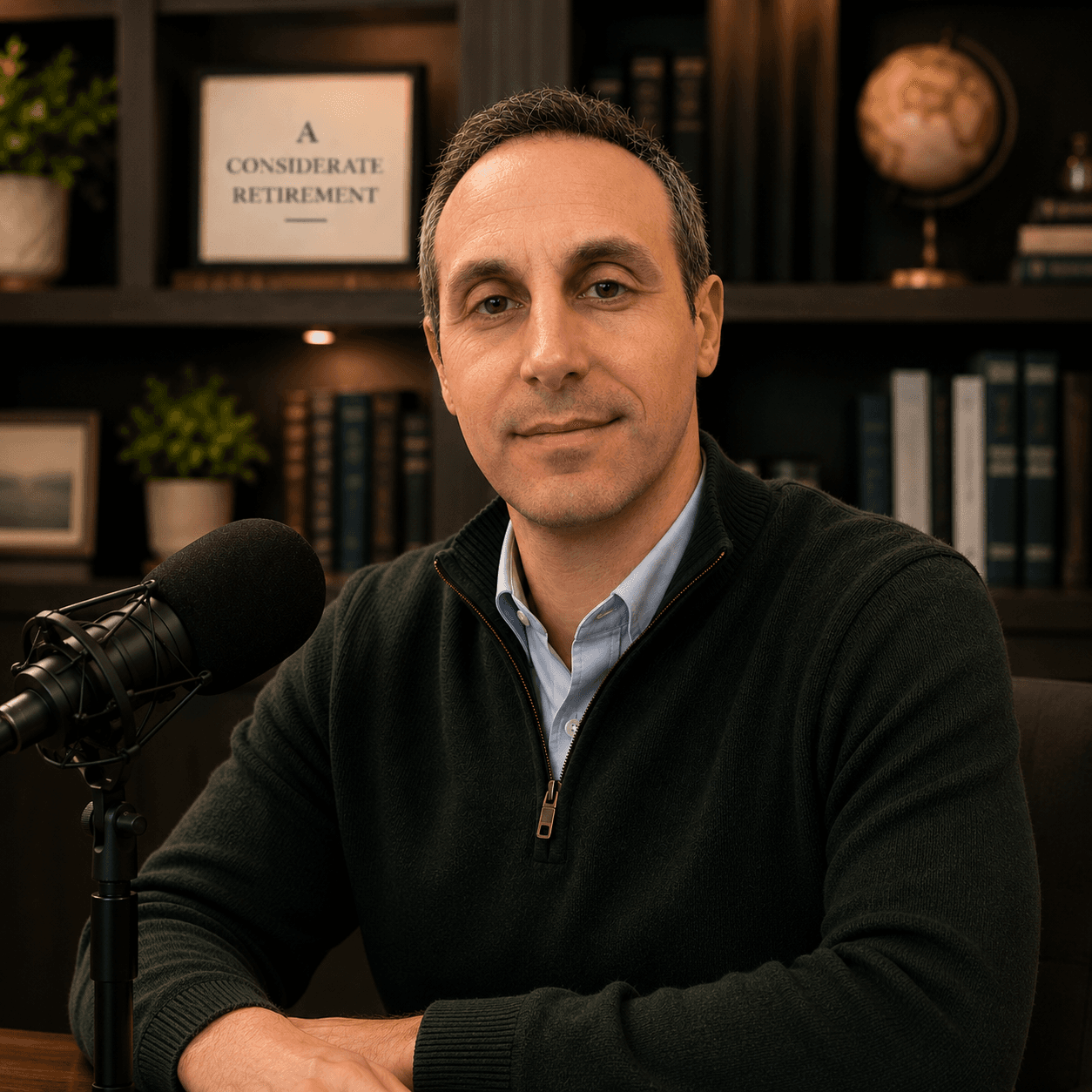
Joshua Mangoubi, CFA
Founder and Chief Investment Officer of Considerate Capital, a fee-only fiduciary. Each episode takes one real retirement question and turns it into a useful, unhurried conversation.
Please read carefully. The full text is also available on the Disclosures page and in our Form ADV Part 2A.
Considerate Capital, LLC ("Considerate Capital") is a Registered Investment Adviser. Registration does not imply any level of skill or training. Advisory services are available only to United States residents. For information pertaining to our registration status, the fees we charge and how we are compensated, additional costs that may be incurred, our conflicts of interest, any disclosed disciplinary events of the Firm or its personnel, and the types of services we offer, please contact us directly or refer to the Investment Adviser Public Disclosure website (www.adviserinfo.sec.gov) to obtain a copy of our disclosure statement, Form ADV Part 2A. In addition, our Privacy Notice outlines how we handle your non-public personal information. Please read these documents carefully before you make a decision to engage Considerate Capital.
This material is limited to the dissemination of general information about Considerate Capital's investment advisory and financial planning services that is not suitable for everyone. Nothing herein should be interpreted or construed as investment advice, nor as legal, tax or accounting advice, nor as personalized financial planning, tax planning, or wealth management advice. For legal, tax and accounting-related matters, we recommend you seek the advice of a qualified attorney or accountant. This material is not a substitute for personalized investment or financial planning from Considerate Capital. There is no guarantee that the views and opinions expressed herein will come to pass, and the information herein should not be considered a solicitation to engage in a particular investment or financial planning strategy. The statements and opinions expressed in this material are relevant as of the date of publication and are subject to change without notice based on changes in the law and other conditions.
Investing in the markets involves gains and losses and may not be suitable for all investors. Past performance is not indicative of future results. Information herein is subject to change without notice and should not be considered a solicitation to buy or sell any security or to engage in a particular investment or financial planning strategy. Individual client asset allocations and investment strategies differ based on varying degrees of diversification and other factors. Diversification does not guarantee a profit or guarantee against a loss.
Some content on this website is produced with the assistance of artificial intelligence tools and is reviewed by a Considerate Capital adviser prior to publication. We make reasonable efforts to ensure accuracy but cannot guarantee that all AI-assisted content is free from error. References to third-party authors, books, tools, custodians, or other external sources are for informational purposes only and do not constitute an endorsement. If you identify an inaccuracy, please contact us so we can review and correct it.
Calculators and reference pages on this website are educational tools for your own use. They apply published rules and official figures to the numbers you enter, produce hypothetical estimates under stated assumptions, and are not personalized advice or a guarantee of any result. Figures change when the law changes. Do not rely on a result without consulting a qualified professional. Their use, and any website's permission to link to or display them, is governed by the Terms for the Tools at consideratecapital.com/tools/terms.
Considerate Capital does not solicit, publish, or use client testimonials or endorsements. Any quotation, story, or reference to an individual on this website is illustrative or educational in nature and is not a testimonial regarding the firm's advisory services. Mention of a third-party author, podcast guest, or public figure is not an endorsement of Considerate Capital by that person, nor an endorsement of that person by Considerate Capital.
Any social media account operated by Considerate Capital is intended for general communication and educational content. Social platforms are not a secure channel and should not be used to share personal financial information or to give instructions about your account. Comments, replies, or messages posted by third parties do not reflect the views of the firm and are not reviewed for accuracy.