
Trust Income Tax Brackets
What does a trust pay on the income it keeps, and what would a beneficiary pay on the same dollars? Every piece below can be linked to, so it opens in a window on your reader's screen, current as of the record. No form to fill in.
2026 law · Reviewed September 4, 2026 · The full page, with methodology and sources · the terms · All tools
Embed the calculator in your page
Taxable income in; the trust's federal tax out, beside what a single beneficiary or a married couple would pay on the same dollars. With the surtax toggle. In a frame it carries no cookies, no tracking, and a visible link back to the methodology. Your site has to allow frames; most do. The link that opens it in a small window is on the professionals page.
Show the code
- In plain words.
- A trust is a legal container that holds money for someone. If the trust keeps the interest and dividends it earns instead of paying them out, the trust itself owes income tax, and its tax brackets are squeezed: it reaches the highest rate at about sixteen thousand dollars of income, where a person would need hundreds of thousands. This tool computes that tax, plus the extra 3.8 percent surtax on investment income, and shows the person's tax beside it.
- Why it matters.
- A trustee decides every year whether to keep income in the trust or pay it out. This is the first number in that decision: what keeping it costs.
- An example.
- A trust that keeps $50,000 of dividends owes about $16,400 of income tax plus about $1,300 of surtax. A single person with no other income would owe about $6,500 on the same $50,000.
- Where it stops.
- It does not work out how much of the income can be paid out, the trust's own fees and deductions, state tax, or the lower rates on qualified dividends and long-term gains. The distribute-or-retain tool takes the next step.
The facts
Six quotable sentences from the 2026 rate tables. Quote them with the year attached.
The button shows exactly what your reader sees when they click the link. Paste the link where a link goes; it opens this list in a small window, always current as of the record, with the attribution and a link to the full page. Nothing to copy out, nothing to update later.
Show the code
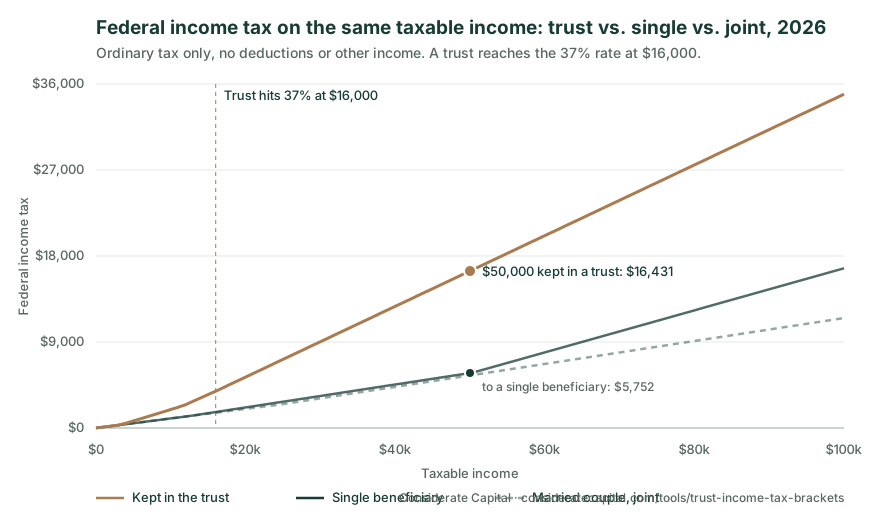
- A trust or estate reaches the top 37% federal rate at $16,000 of taxable income in 2026. A single filer reaches it at $640,600; a married couple filing jointly at $768,700.
- The estates-and-trusts table has four brackets: 10% to $3,300, 24% to $11,700, 35% to $16,000, and 37% above that. There is no 12%, 22%, or 32% bracket for a trust.
- On $50,000 of taxable income kept in a trust, the federal income tax is $16,431, 32.9% of the income. The same $50,000 in the hands of a single beneficiary with no other income draws $5,752; a married couple, $5,504.
- The 3.8% net investment income surtax starts at $16,000 for a trust, where its top bracket begins. For individuals the threshold is $200,000 single and $250,000 joint, and it has not been indexed since 2013.
- Long-term capital gains inside a trust are taxed at 0% up to $3,300, 15% up to $16,250, and 20% above that in 2026. A single filer's 15% band runs to $545,500.
- Income a trust distributes to beneficiaries within its distributable net income is deducted by the trust and taxed to them instead. A trustee has until the 65th day of the following year to make a distribution count for the prior year.
The compression chart
Three lines, $0 to $100,000: the trust, a single beneficiary, a married couple. The year and attribution are drawn in.
The button shows exactly what your reader sees when they click the link. Paste the link where a link goes; it opens this chart in a small window, always current as of the record, with the attribution and a link to the full page. Nothing to copy out, nothing to update later.
Show the code
The trust brackets
The four-bracket schedule, exactly as the revenue procedure states it.
The button shows exactly what your reader sees when they click the link. Paste the link where a link goes; it opens this table in a small window, always current as of the record, with the attribution and a link to the full page. Nothing to copy out, nothing to update later.
Show the code
| Taxable income | Rate | The tax is |
|---|---|---|
| $0 to $3,300 | 10% | 10% of taxable income |
| $3,300 to $11,700 | 24% | $330 plus 24% of the excess over $3,300 |
| $11,700 to $16,000 | 35% | $2,346 plus 35% of the excess over $11,700 |
| Over $16,000 | 37% | $3,851 plus 37% of the excess over $16,000 |
Trust vs. individual, by income
The compression in one table: the same dollars, three owners. Ordinary tax only; no deductions, no surtax, no state tax.
The button shows exactly what your reader sees when they click the link. Paste the link where a link goes; it opens this table in a small window, always current as of the record, with the attribution and a link to the full page. Nothing to copy out, nothing to update later.
Show the code
| Taxable income | Kept in a trust | Trust effective rate | Single beneficiary | Married couple, joint |
|---|---|---|---|---|
| $10,000 | $1,938 | 19.4% | $1,000 | $1,000 |
| $16,000 | $3,851 | 24.1% | $1,672 | $1,600 |
| $25,000 | $7,181 | 28.7% | $2,752 | $2,504 |
| $50,000 | $16,431 | 32.9% | $5,752 | $5,504 |
| $100,000 | $34,931 | 34.9% | $16,712 | $11,504 |
| $250,000 | $90,431 | 36.2% | $56,456 | $45,196 |
Cite and link.
The clean address, a citation generated from the record so it can never carry a stale review date, and an address for every section so you can point a reader at the exact table or method.
Show the code
- Link
- https://consideratecapital.com/tools/trust-income-tax-brackets
- Citation
- Considerate Capital, "Trust Income Tax Brackets," reviewed September 4, 2026, https://consideratecapital.com/tools/trust-income-tax-brackets.
Link to a section
- The calculator https://consideratecapital.com/tools/trust-income-tax-brackets#calculator
- The facts https://consideratecapital.com/tools/trust-income-tax-brackets#facts
- Key numbers https://consideratecapital.com/tools/trust-income-tax-brackets#key-numbers
- How trusts are taxed https://consideratecapital.com/tools/trust-income-tax-brackets#how-it-works
- Worked examples https://consideratecapital.com/tools/trust-income-tax-brackets#examples
- The compression chart and the comparison table https://consideratecapital.com/tools/trust-income-tax-brackets#chart
- Methodology https://consideratecapital.com/tools/trust-income-tax-brackets#methodology
- Sources https://consideratecapital.com/tools/trust-income-tax-brackets#sources
- Revision history https://consideratecapital.com/tools/trust-income-tax-brackets#revision-history
Everything here reads from one reviewed record, so a copied piece carries its year and its review date. When the law moves, the embed updates by itself; a copied table or chart keeps the year in its caption. Corrections are welcome through the contact page.