

You were never your job title.
For forty years, what you did was a complete answer to who you are. Retirement is the morning that answer goes quiet, and you learn how much of you was the title.

Hosted by Joshua Mangoubi, CFAFounder, Considerate Capital
Double-click any word to play from there.
What do you do?
For forty years you had the answer before the question finished landing.
You said the title, the firm, the specialty, and that short sentence carried a lot more than it seemed to.
It placed you in the room.
It told the other person how to treat you.
And it told you who you were, right while you were saying it.
Then one day you retire.
A few weeks later, a new neighbor asks the same three words.
And you hear yourself say, "I'm retired."
Which isn't really an answer to what you do.
It's an answer to what you stopped doing.
And in that little half-second pause, where the old sentence used to be, sits a question you didn't expect to be holding at sixty-five.
If you're not the thing on the business card... who are you?
This is A Considerate Retirement.
I'm Josh Mangoubi, and I spend my days helping people build retirements that actually feel like their own.
And today I want to talk about the part of retirement that no spreadsheet warns you about.
The morning your job title goes quiet, and you find out how much of you was wrapped up in it.
Because this is what I've come to believe.
You were never actually your job title.
You just played the role so well, for so long, that you forgot it was a role.
Let me show you what I mean.
Think about what a job really becomes by the end.
It's rarely just work anymore.
Over a few decades, it turns into the frame the whole rest of your day hangs on.
It held your structure.
The meetings, the deadlines, the thing that decided when you got up and what shape the week had.
It held your standing.
The way a room shifted a little when you walked in.
The calls returned the same day.
The sense of being someone whose opinion people waited for.
It held your belonging.
The people who knew you, because you all did the same hard thing together.
And it kept score.
The projects finished, the problems solved, the steady proof that you were good at something.
Now the tricky part.
All of that comes off on the same afternoon.
And the title comes off with it.
A picture helps me here.
Think of a climbing vine on a trellis.
For years the vine grows up the trellis, wraps around it, leans on it, takes its whole shape from it.
And if you pull the trellis out of the ground one afternoon, the vine sags.
It flops onto the dirt, and for a while it looks like the plant is dying.
But the plant was never the trellis.
The vine is still alive.
It's still itself.
It just needs something new to grow up.
That's you, the morning after.
The support that shaped you for forty years is gone.
And the sagging feeling is real.
But you are not the trellis.
You never were.
So that's the first thing to hold onto.
What came off that afternoon was a support, not the self that grew up around it.
Now let me make this a person, because it's easy to talk about in the abstract, and it's a lot harder at the kitchen table.
Picture a man — let's call him Walt.
Walt isn't real.
He's a composite, a stand-in, so we can make this concrete.
Walt was a surgeon.
More than thirty years of it.
The good kind of busy, the kind where people needed him and he knew it.
Say he retires at sixty-four, with a wife named Nadia, a paid-off house, and enough saved that the money is genuinely fine.
The first couple of weeks feel like a long-earned vacation.
And then week three arrives, and there's a Tuesday with nothing in it.
Nobody paging him.
Nobody waiting on his opinion.
The tally that ran in the back of his head for three decades — cases done, problems solved — just stopped counting.
And Walt, who could stay calm through a twelve-hour operation, finds himself weirdly rattled by an empty Tuesday.
What I'd gently say to Walt, and to anyone who recognizes this, is simple.
Don't be embarrassed by how much it stings.
Even if retiring was your own idea.
Even if the numbers are great.
A life gets used to its shape.
It gets used to the roles, the routines, and the people who recognize you.
Pull out the central one, and the whole structure wobbles for a while.
That's not weakness.
That's just how identity works.
On an old scale researchers use for major life changes, retirement sits near marriage.
Not close to losing a spouse.
But not close to nothing, either.
It's a genuine passage.
And it tends to hit the most accomplished people the hardest.
The surgeon, the founder, the partner whose name was on the door.
Because the more of yourself you poured into the role, the bigger the hole when the role is gone.
There was simply more of Walt inside that job.
The human part is underneath the money.
What Walt is really missing on that empty Tuesday isn't only the operating room.
Often, the ache underneath the work is about being needed.
And that's the takeaway here.
The ache isn't really about work.
It's about mattering to somebody — and that's a thing you can rebuild, just not with a title.
So what do you actually do with the blank space?
Let me offer a few things to weigh, not instructions — just what tends to help.
First, watch what you reach for.
The most natural move in the world is to grab the nearest thing that gives back the old feeling of importance.
The board seat.
The new consulting role.
The volunteer group you quietly start running like a division.
Sometimes those are wonderful.
And sometimes they're the same title in a new suit, and they leave you just as hollow.
There's a clean little test for this that I love.
There are two very different ways to love an activity.
One is freely chosen, it fits with the rest of your life, and it gives energy back.
The other feels more pressured.
It looks like passion, but it's really about proving something — it's doing the thing for what it does for your standing.
And that second kind quietly drains you.
The test isn't the activity itself.
It's the motive underneath.
And the question that gets to it is this.
Would you still do this thing if no one were watching, and no one were impressed?
Second, don't try alone to think your way to a new self.
The research is clear about this.
Your identity was never really a solo project.
It was always reflected back to you by the people around you.
And when you retire, the nearest mirror — the one made of colleagues and clients — goes dark fast.
Those casual work ties tend to fall away within the first year.
What's left, and what becomes most of your mirror now, is the close circle.
The spouse.
The few real friends.
The family.
Which means Nadia is now a much bigger part of how Walt sees himself.
So the lonely move is to disappear into your own head and try to solve it there.
A new self gets built in conversation.
In the company of people who ask who you are now — not what you used to be.
Third, if you haven't retired yet, there's a gentler way in.
Easing out instead of cutting the cord.
Staying on part-time, or in an advisory seat, for a while — so the new self has time to take root before the old one is fully gone.
The hardest landings tend to be the abrupt ones.
And one honest caution.
For most people, the low eases over the first year or two as the new shape settles.
But for a few, it doesn't lift.
The flatness hardens into a real depression that the months don't move.
If that's nearer your experience, please treat it as exactly what it is.
Talk to a doctor or a good therapist.
There's no toughing this one out, and no medal for trying.
So the takeaway for this stretch.
The goal isn't to refill the calendar fast.
It's to choose the next thing because it's yours — not because it makes you feel like somebody again.
Your Considerate Step this week is this.
Pick one thing you're already doing, or thinking about taking on.
The committee, the consulting call, the round of golf, the new project.
And ask yourself that one honest question.
Would I still do this if no one were watching, and no one were impressed?
Just sit with the answer for a minute.
You're not deciding anything.
You're just listening for whether it's really yours, or just the old trellis in a different place.
Let me leave you back with Walt.
Picture him a year later, on another quiet Tuesday.
Only this time the quiet doesn't rattle him.
He's out in the yard with something he's been tending, and Nadia's asking him about it, and he's telling her — not about who he used to be, about what he's into now.
The tally in his head isn't counting cases anymore.
It's just not counting.
And that turns out to be fine.
Because the blank space where the title used to be was never emptiness.
It was room.
The first time in decades that the sentence after "I am" was his to write, instead of handed to him with a lanyard.
Over at a considerate retirement dot com, this one sits beside the episode called A retirement needs somewhere to go, which asks the next Walt-and-Nadia question — once the title is gone, where do the open days go?
And if this episode found you in one of those empty Tuesdays, be gentle with yourself.
Money will not tell you who you are.
But a plan with room in it can give you time to rebuild without a clock running, and the freedom to choose the next thing because it's genuinely yours, and not because it has to pay.
A person who must take the next role for the income doesn't get to ask whether it's the right role.
A person whose plan has room in it does.
If you want your plan to leave room for the empty Tuesdays, there's time set aside on our schedule page whenever you're ready.
One quick, important note.
I'm the founder of Considerate Capital, a registered investment adviser, and this show is educational and general — not personal financial, medical, tax, or legal advice, and not a recommendation for your situation.
Anyone I describe, Walt and Nadia included, is a hypothetical composite, not a real client.
And nothing here is a promise of results.
For advice about your own life, talk with a professional who knows the details.
And if that low hardens and won't lift, the right professional is a doctor or a therapist.
I'm Josh Mangoubi.
This week, ask the one activity whether you'd still choose it if no one were watching — and leave yourself a little room on the empty Tuesday.
I'll see you next time.
You were never your job title.
Prefer to read? This episode was adapted from the essay.


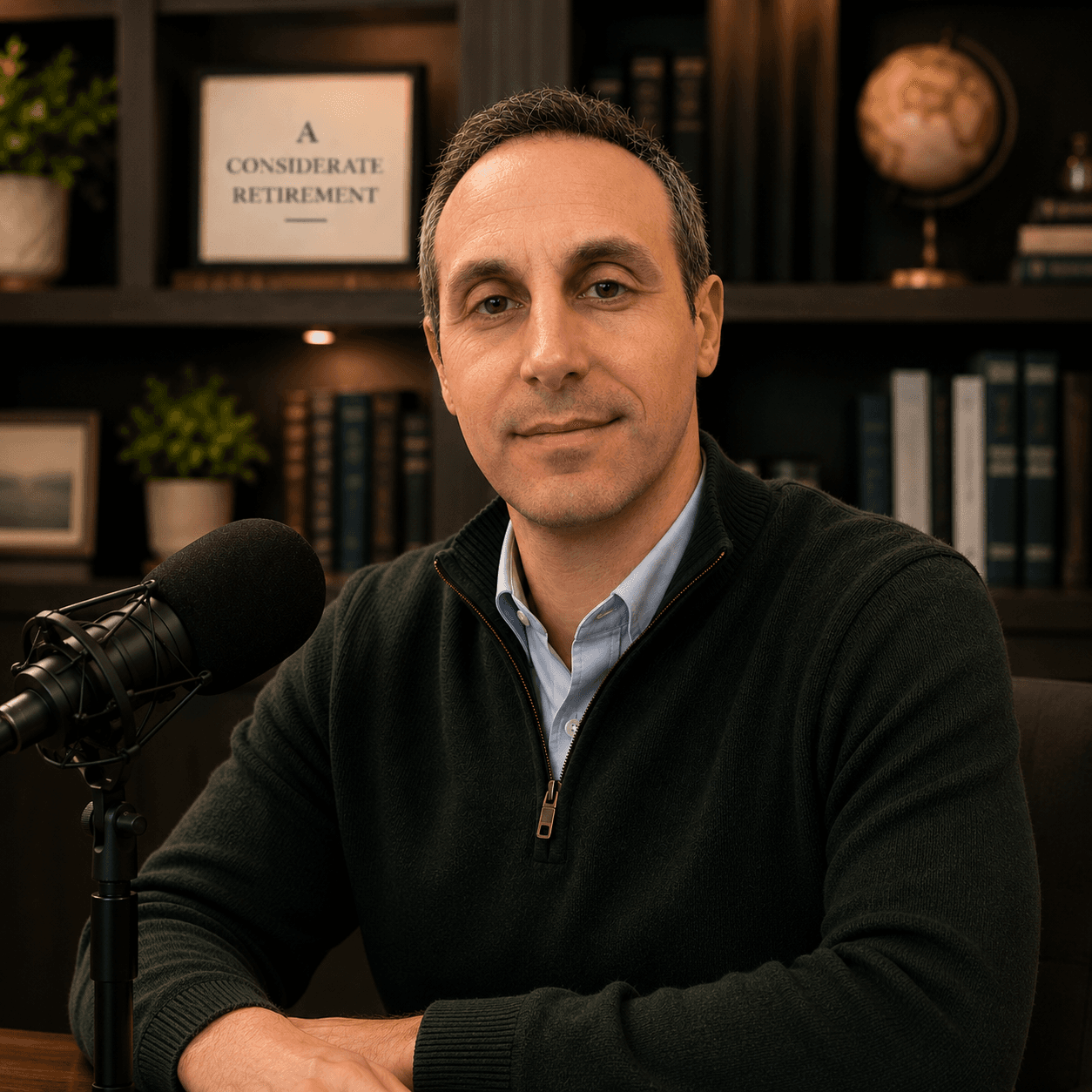
Joshua Mangoubi, CFA
Founder and Chief Investment Officer of Considerate Capital, a fee-only fiduciary. Each episode takes one real retirement question and turns it into a useful, unhurried conversation.
Please read carefully. The full text is also available on the Disclosures page and in our Form ADV Part 2A.
Considerate Capital, LLC ("Considerate Capital") is a Registered Investment Adviser. Registration does not imply any level of skill or training. Advisory services are available only to United States residents. For information pertaining to our registration status, the fees we charge and how we are compensated, additional costs that may be incurred, our conflicts of interest, any disclosed disciplinary events of the Firm or its personnel, and the types of services we offer, please contact us directly or refer to the Investment Adviser Public Disclosure website (www.adviserinfo.sec.gov) to obtain a copy of our disclosure statement, Form ADV Part 2A. In addition, our Privacy Notice outlines how we handle your non-public personal information. Please read these documents carefully before you make a decision to engage Considerate Capital.
This material is limited to the dissemination of general information about Considerate Capital's investment advisory and financial planning services that is not suitable for everyone. Nothing herein should be interpreted or construed as investment advice, nor as legal, tax or accounting advice, nor as personalized financial planning, tax planning, or wealth management advice. For legal, tax and accounting-related matters, we recommend you seek the advice of a qualified attorney or accountant. This material is not a substitute for personalized investment or financial planning from Considerate Capital. There is no guarantee that the views and opinions expressed herein will come to pass, and the information herein should not be considered a solicitation to engage in a particular investment or financial planning strategy. The statements and opinions expressed in this material are relevant as of the date of publication and are subject to change without notice based on changes in the law and other conditions.
Investing in the markets involves gains and losses and may not be suitable for all investors. Past performance is not indicative of future results. Information herein is subject to change without notice and should not be considered a solicitation to buy or sell any security or to engage in a particular investment or financial planning strategy. Individual client asset allocations and investment strategies differ based on varying degrees of diversification and other factors. Diversification does not guarantee a profit or guarantee against a loss.
Some content on this website is produced with the assistance of artificial intelligence tools and is reviewed by a Considerate Capital adviser prior to publication. We make reasonable efforts to ensure accuracy but cannot guarantee that all AI-assisted content is free from error. References to third-party authors, books, tools, custodians, or other external sources are for informational purposes only and do not constitute an endorsement. If you identify an inaccuracy, please contact us so we can review and correct it.
Calculators and reference pages on this website are educational tools for your own use. They apply published rules and official figures to the numbers you enter, produce hypothetical estimates under stated assumptions, and are not personalized advice or a guarantee of any result. Figures change when the law changes. Do not rely on a result without consulting a qualified professional. Their use, and any website's permission to link to or display them, is governed by the Terms for the Tools at consideratecapital.com/tools/terms.
Considerate Capital does not solicit, publish, or use client testimonials or endorsements. Any quotation, story, or reference to an individual on this website is illustrative or educational in nature and is not a testimonial regarding the firm's advisory services. Mention of a third-party author, podcast guest, or public figure is not an endorsement of Considerate Capital by that person, nor an endorsement of that person by Considerate Capital.
Any social media account operated by Considerate Capital is intended for general communication and educational content. Social platforms are not a secure channel and should not be used to share personal financial information or to give instructions about your account. Comments, replies, or messages posted by third parties do not reflect the views of the firm and are not reviewed for accuracy.