

Three million at sixty is a two-part retirement.
Whether it carries you depends less on the number than on the seven years your portfolio works alone, before Social Security arrives to share the load.

Hosted by Joshua Mangoubi, CFAFounder, Considerate Capital
Double-click any word to play from there.
Imagine Celeste at two in the morning.
Sixty years old, three million dollars saved, and still wide awake.
Not over the number.
Over something smaller, and more human.
Imagine her husband Marco asleep beside her.
They're not real clients, just a composite of a very common question.
From the outside, it looks like enough.
So why is she awake?
She doesn't want to become a burden to her kids.
She's quietly scared of the five years before Medicare, when one bad diagnosis could change the math.
And she'd like to take the grandkids somewhere someday without doing arithmetic at the dinner table.
This is A Considerate Retirement.
I'm Josh Mangoubi, and I spend my days helping people think clearly about exactly this moment.
Here's what I want you to hear today.
Three million at sixty is not one long retirement.
It's a retirement in two parts.
And whether it carries you depends far less on the number than on seven quiet years at the start — the years your money works alone, before Social Security shows up to share the weight.
Let's start with the arithmetic everyone reaches for.
There's an old rule of thumb — the four percent rule.
You withdraw four percent the first year, then adjust it for inflation each year after.
On three million dollars, that's a hundred and twenty thousand in the first year.
But here's the thing.
That rule was built for a retirement of about thirty years.
Retire at sixty, and you might be planning for thirty years or more.
So a lot of planners start a little lower — closer to three or three and a half percent — to leave room for a rough decade.
At three and a half percent, three million produces about a hundred and five thousand dollars in that first year.
Now, is that enough?
Here's the honest yardstick.
Most people need to replace roughly seventy to eighty percent of what they were living on before they stopped.
If you were living on a hundred and forty thousand after taxes, three million can likely do it.
If you were living on three hundred thousand, it can't — and the kindest thing I can tell you is that three million just isn't your number.
That's the line where becoming a burden stops being a fear and turns into plain math.
But hold on to the number a hundred and five thousand, because the real story isn't the size of the withdrawal.
It's the shape of it.
So let me give you a picture.
Imagine a long hike.
You've got a heavy pack, and for the first seven miles, you carry the whole thing yourself.
Every ounce of it.
Then you reach a trail junction, and a friend is waiting there.
She takes part of the load, and you walk the rest of the way sharing the weight.
That's retiring at sixty.
In Celeste and Marco's example, the first phase runs from sixty to about sixty-seven.
If they wait to claim Social Security, nearly every dollar they spend comes out of the portfolio.
The pack is fully on their backs.
Then, around sixty-seven, Social Security arrives.
For someone reaching full retirement age, that check might be around thirty-six thousand dollars a year.
The moment it starts, the amount you pull from savings drops — and so does the strain.
That's your friend at the trail junction, taking part of the load.
And here's the part I love about that check.
A market can't touch it.
It arrives every month no matter what stocks did last year.
So a plan that looks tight when you imagine pulling a hundred and five thousand dollars a year for thirty straight years?
That's not actually the plan.
The plan is seven years alone, and then a handoff.
The takeaway is simple.
The fear most people carry is the thirty-year version, where the money runs alone the whole way.
That's not the version you're facing.
Now let's put Celeste and Marco back on that first seven miles, because that's where the real work is.
Two things sit inside those bridge years, and they deserve their full attention.
The first is health insurance.
Medicare doesn't start until sixty-five.
So retiring at sixty means about five years of buying their own coverage — usually through the Affordable Care Act marketplace.
That's a real cost.
And notice where it lands — in exactly the years the portfolio is already working hardest, with no help coming yet.
That's Celeste's diagnosis fear, given a dollar figure.
The second thing is quieter, and it's actually good news.
From sixty to sixty-seven, their taxable income is often unusually low.
No Social Security yet.
And the required withdrawals from traditional retirement accounts — the money the government eventually forces you to take out — don't begin until seventy-three.
So there's this window.
A low-tax window that won't stay open.
One way to use it is to move some traditional savings into a Roth account, paying the tax now, while the rate is low.
That's called a Roth conversion.
And here's why it matters, and it's not really about this year's tax bill.
If Marco dies first, picture Celeste filing on her own.
When one spouse is left, the tax brackets get narrower.
A single person can owe more tax on the same income than a couple did.
The smaller tax bill you build now is the one Celeste may face alone, years from now.
That's the squeeze you don't want to leave behind for the person you most wanted to protect.
This is worth mapping carefully with a tax advisor or C-P-A — it's genuinely their department, not mine.
And keep one eye on your income, because crossing certain limits in a year can quietly raise your Medicare premiums about two years later.
You don't need a fancy term for it.
The point is simple: income choices now can affect Medicare premiums later.
The takeaway here?
Those first seven years aren't just the risky stretch.
They're also the opening — a brief chance to make the second half of the plan gentler on the person left behind.
So what do you actually do with all this?
Let me offer a few things to weigh — not instructions, just the levers.
The first is a cash buffer.
The real danger in early retirement isn't a bad market someday.
It's a bad market right now, in year one or two, while you're selling investments to live.
Because those losses get locked in, and the shares are gone.
A few years of spending held in cash and short-term, high-quality bonds keeps a downturn from forcing you to sell at the bottom.
That buffer isn't about earning a return.
It's what lets Celeste keep paying for her own health coverage in a scary market — without selling stocks into it.
The second lever is spending by a rule, not a fixed number.
No plan survives thirty years of being followed to the exact dollar.
So instead, you set simple guardrails.
Say you start at a hundred and five thousand a year.
If a long slump drags the portfolio down toward two and a half million, you trim spending by about ten percent — down to ninety-five thousand — for a year or two.
If markets run well and it climbs toward three point seven million, you give yourself a raise, up to a hundred and fifteen thousand.
In between, you hold steady.
Now, the hard part isn't the rule.
It's following it in the middle of a frightening market, which is exactly when it counts.
And here's what people get backwards.
The trim they dread — the year they cut spending ten percent — is rarely what costs them the trip with the grandkids.
What costs them that trip is never agreeing to a rule in the first place.
So they freeze instead.
And one more slow risk worth naming.
Inflation.
At three percent a year, prices roughly double in about twenty-four years.
So the hundred and five thousand that feels comfortable at sixty has to buy the same life at eighty-five.
That's the version of becoming a burden that sneaks up with no bad year on any statement.
Nothing went wrong.
The check just stopped reaching as far.
Which is why a careful plan assumes you're still here, and still comfortable, at ninety.
The takeaway from all of this?
The people who feel steadiest about retiring at sixty are rarely the wealthiest.
They're the ones who saw the two-part shape coming, and arranged those first seven years so the market had very little power to scare them.
Your Considerate Step this week is: find your trail junction.
Take the age you'd want to stop working, and the age you'd claim Social Security, and count the years between them.
Just that number.
Because that gap — five years, seven years, whatever it is — is how long your portfolio walks alone before help arrives.
And once you can see it, the whole plan stops being one scary thirty-year number and becomes something you can actually walk.
So picture Celeste again, at that trail junction.
Seven miles in, pack finally lighter, Marco beside her, the harder part behind them.
That's the whole idea today.
Three million at sixty isn't a single long haul.
It's seven years alone, then a hand on the other end of the pack — and the plan turns on how well you prepare for those first miles, not on the balance on the day you stop.
At a considerate retirement dot com, you'll find this episode beside The Widow's Penalty.
It picks up the exact thread we left open here — why the spouse left alone can owe more tax on less income, and what the two of you can quietly do about it now, while the low-tax window is still open.
And if you'd like to count your own seven years and see what they really depend on, there's time set aside on our schedule page whenever you're ready.
We can help you map those first miles — and for the Roth conversion piece, we'll gladly work alongside your tax advisor or C-P-A.
One quick, important note.
I'm the founder of Considerate Capital, a registered investment adviser, and this show is educational and general — not personal financial, tax, or legal advice, and not a recommendation for your situation.
Anyone I describe, Celeste and Marco included, is a hypothetical composite, not a real client.
And nothing here is a promise of results.
For advice about your own life, talk with a professional who knows the details.
I'm Josh Mangoubi.
Sometime this week, count the years between the day you'd stop and the day the check arrives — because that gap is the part of the trail you'll walk alone.
Until next time, find your trail junction before you step onto the bridge.
Three million at sixty is a two-part retirement.
Prefer to read? This episode was adapted from the essay.


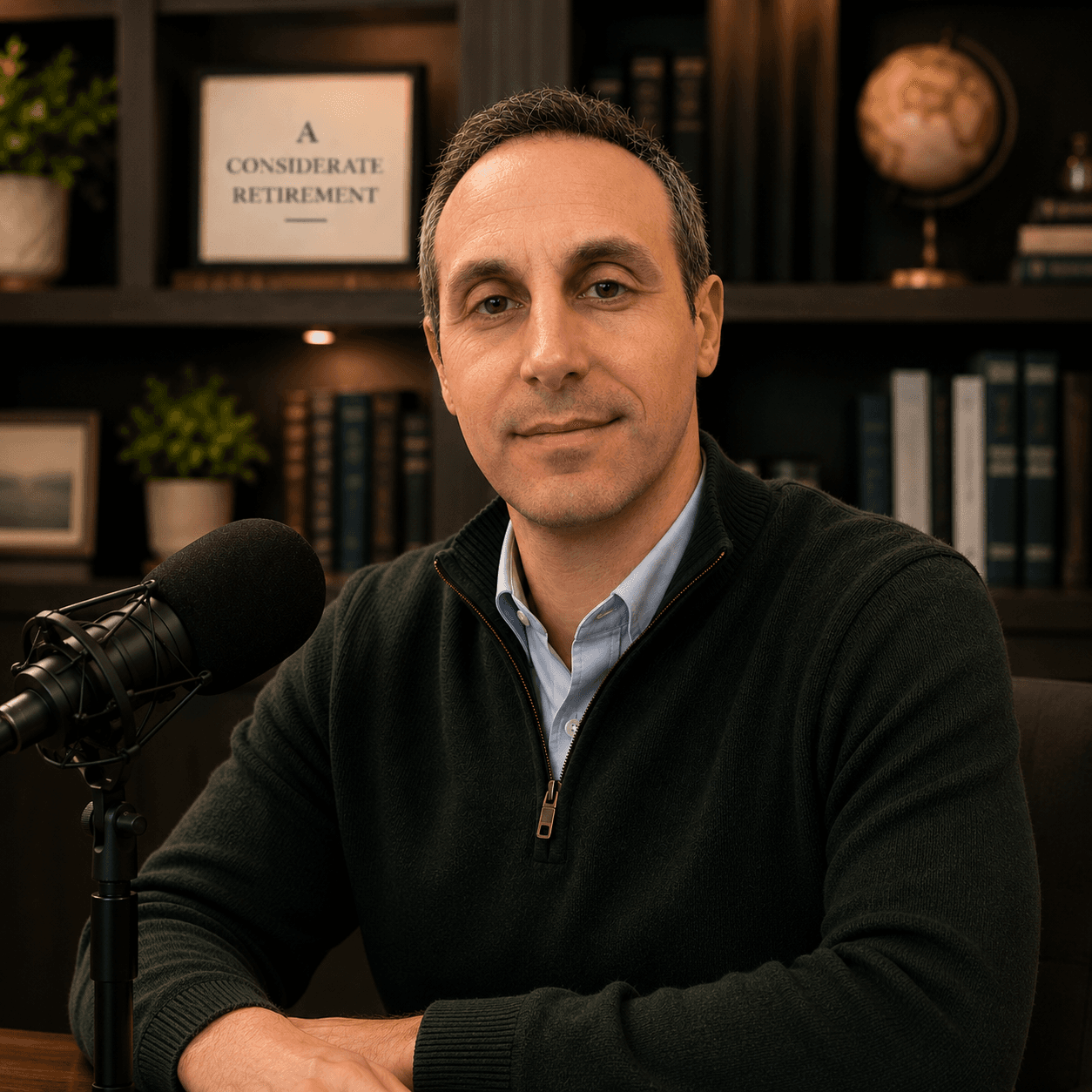
Joshua Mangoubi, CFA
Founder and Chief Investment Officer of Considerate Capital, a fee-only fiduciary. Each episode takes one real retirement question and turns it into a useful, unhurried conversation.
Please read carefully. The full text is also available on the Disclosures page and in our Form ADV Part 2A.
Considerate Capital, LLC ("Considerate Capital") is a Registered Investment Adviser. Registration does not imply any level of skill or training. Advisory services are available only to United States residents. For information pertaining to our registration status, the fees we charge and how we are compensated, additional costs that may be incurred, our conflicts of interest, any disclosed disciplinary events of the Firm or its personnel, and the types of services we offer, please contact us directly or refer to the Investment Adviser Public Disclosure website (www.adviserinfo.sec.gov) to obtain a copy of our disclosure statement, Form ADV Part 2A. In addition, our Privacy Notice outlines how we handle your non-public personal information. Please read these documents carefully before you make a decision to engage Considerate Capital.
This material is limited to the dissemination of general information about Considerate Capital's investment advisory and financial planning services that is not suitable for everyone. Nothing herein should be interpreted or construed as investment advice, nor as legal, tax or accounting advice, nor as personalized financial planning, tax planning, or wealth management advice. For legal, tax and accounting-related matters, we recommend you seek the advice of a qualified attorney or accountant. This material is not a substitute for personalized investment or financial planning from Considerate Capital. There is no guarantee that the views and opinions expressed herein will come to pass, and the information herein should not be considered a solicitation to engage in a particular investment or financial planning strategy. The statements and opinions expressed in this material are relevant as of the date of publication and are subject to change without notice based on changes in the law and other conditions.
Investing in the markets involves gains and losses and may not be suitable for all investors. Past performance is not indicative of future results. Information herein is subject to change without notice and should not be considered a solicitation to buy or sell any security or to engage in a particular investment or financial planning strategy. Individual client asset allocations and investment strategies differ based on varying degrees of diversification and other factors. Diversification does not guarantee a profit or guarantee against a loss.
Some content on this website is produced with the assistance of artificial intelligence tools and is reviewed by a Considerate Capital adviser prior to publication. We make reasonable efforts to ensure accuracy but cannot guarantee that all AI-assisted content is free from error. References to third-party authors, books, tools, custodians, or other external sources are for informational purposes only and do not constitute an endorsement. If you identify an inaccuracy, please contact us so we can review and correct it.
Calculators and reference pages on this website are educational tools for your own use. They apply published rules and official figures to the numbers you enter, produce hypothetical estimates under stated assumptions, and are not personalized advice or a guarantee of any result. Figures change when the law changes. Do not rely on a result without consulting a qualified professional. Their use, and any website's permission to link to or display them, is governed by the Terms for the Tools at consideratecapital.com/tools/terms.
Considerate Capital does not solicit, publish, or use client testimonials or endorsements. Any quotation, story, or reference to an individual on this website is illustrative or educational in nature and is not a testimonial regarding the firm's advisory services. Mention of a third-party author, podcast guest, or public figure is not an endorsement of Considerate Capital by that person, nor an endorsement of that person by Considerate Capital.
Any social media account operated by Considerate Capital is intended for general communication and educational content. Social platforms are not a secure channel and should not be used to share personal financial information or to give instructions about your account. Comments, replies, or messages posted by third parties do not reflect the views of the firm and are not reviewed for accuracy.