

The loneliness no one plans for.
No one budgets for it, but retirement can quietly shrink the week's human contact down to almost nothing. This is why that thinning matters to your health, and how the connection gets rebuilt.

Hosted by Joshua Mangoubi, CFAFounder, Considerate Capital
Double-click any word to play from there.
You notice it on a Wednesday, with a coffee cup in your hand.
You're rinsing it in the sink, and it lands on you, quietly, that you haven't had a real conversation with anyone outside this house since the weekend.
Not a transaction. The man at the hardware store doesn't count. Neither does the nod to the neighbor backing out of the driveway. I mean the real kind. The kind where someone asks how you actually are, and then waits for the answer. The kind that used to happen six times before lunch without your ever arranging it.
And you add it up, and the number is close to zero, and it surprises you.
Because nobody warned you it could get that low.
I'm Josh Mangoubi, and this is A Considerate Retirement — the show for people trying to notice the parts of retirement that don't show up on a statement. Today we're talking about the thing almost nobody puts in the plan. You ran the numbers on the money for years. You did not run them on the people. And the people, it turns out, were mostly coming from one place.
Let me give you a couple to hold onto. Picture two people, married a long time. Let's call them Rosa and Dev. Completely invented — I'm using them to make this real, not because they're anyone in particular.
Rosa retired first, from a job she was good at and tired of. The party was lovely. The relief was real. And about four months in, she's the one at the sink on a Wednesday, doing that quiet arithmetic. Dev is in the next room, sorting the mail. And she feels, in a way she can barely admit out loud, a little bit alone.
Hold onto Rosa. We'll come back to her.
First, let's talk about why the number got so low.
Here's the thing about work. Work hands you company whether you want it or not.
For decades, your day arrived pre-stocked with other humans. The people you ate lunch beside. The one you complained to about the same meeting. The colleague who knew the whole long story of the project, because they lived it with you.
You didn't think of most of them as friends, exactly. They were just… there. Every day. And being known by people who are just there every day — that's a large, invisible portion of a life.
Then, on a single Friday, it switches off.
Here's the picture I keep coming back to.
For your whole working life, you were standing on one of those moving walkways at the airport. You didn't have to walk toward people. The floor carried them past you. All day long, coworkers kept arriving beside you.
Retirement is the moment you step off the walkway onto solid ground.
The floor stops moving. And for the first time in your adult life, if you want to end up next to another human being, you have to actually walk over there. On purpose.
The research backs up how fast this happens. Those casual ties from work tend to fall away inside the first year. No falling-out. No drama. They were held in place by the shared building, and nothing else.
What's left is the circle you actually chose. A spouse. A few real friends. Family. That circle is precious. But it's now a much smaller share of a much smaller network — and it's being asked to carry weight it never carried before.
The company you lost was the easy kind, the kind the structure kept up for you at no cost. The company that remains is the kind you have to build and tend by hand.
Here's the takeaway for this part. The supply used to be automatic. The replacement is not.
Now — you might be tempted to file all of this under "feelings" and move on. I want to slow you down there, because the research is the reason not to.
When researchers put together one hundred forty-eight separate studies, following more than three hundred thousand people, they found that having strong social relationships was tied to a fifty percent greater likelihood of surviving over those study periods.
Fifty percent.
You don't need to remember every number that follows. The point is simpler than that.
They judged that effect comparable to the big risks your doctor already nags you about. Things like obesity. Things like not moving your body.
So the size of your social life belongs in the same sentence as those.
The specific diseases line up the way you'd fear. Poor social relationships were linked to about a twenty-nine percent higher risk of heart disease, and about a thirty-two percent higher risk of stroke. Loneliness was tied to about a thirty-one percent higher risk of dementia — and that link held even after accounting for depression. The National Institute on Aging lists the whole crowd that isolation keeps company with. Higher blood pressure. Heart disease. A weaker immune system. Anxiety. Depression. Cognitive decline. Earlier death.
Now, let me be careful and honest with you. None of these numbers say loneliness reaches into your chest and stops your heart. They're patterns across huge groups of people. Any one person's health turns on a hundred things.
But the direction is steady, and the size isn't small. So the honest move is to treat a thinning social life the way you'd treat a blood pressure reading that had started to drift. Not with panic. With attention.
The body, it turns out, keeps a kind of count of how connected you are.
Now, back to Rosa.
Here's what catches people off guard about her. She's married. There's a good man in the next room who loves her. And she's lonely anyway.
I want to say this plainly, because people are so reluctant to say it out loud. You can be lonely inside a perfectly good marriage.
It feels almost ungrateful to admit. You're not alone in the house. Someone's across the breakfast table every morning. And yet a quiet flatness creeps in.
You're not imagining it. More than a third of married older adults say they experience loneliness. And here's a wrinkle — having a lonely spouse makes you more likely to feel lonely yourself.
Because loneliness isn't the same as being by yourself. It's the gap between the connection you have and the connection you need. And a spouse, however dear, was never built to be your entire social world.
This sneaks up on couples in retirement precisely because the togetherness goes up. Rosa and Dev are both home now, all day. And the sheer volume of shared hours gets mistaken for something it isn't.
Two people can be in the same rooms constantly, and slowly stop being curious about each other. The conversation shrinks down to logistics. The dishwasher. The doctor's appointment. What to do about dinner.
Here's what Rosa actually needs. And it isn't more hours with Dev.
It's the wider circle — the friends, the standing coffee, the group of her own — that takes the impossible weight off the marriage. So Dev doesn't have to become the whole world by himself.
Here's the takeaway. A marriage was never meant to be one person's whole world. Give it a world around it, and it gets lighter.
So what do you actually do about the thinning?
The good news is a little boring — which is usually how good news about being human sounds.
Connection can be rebuilt. But it gets rebuilt the same way it was built the first time. Through small, repeated contact. The same faces, on a schedule, until it becomes a tie.
The standing Tuesday coffee. The walking group that meets whether you feel like it or not. The class you signed up for mostly to have somewhere to be on Thursdays. Where the point was never really the pottery.
Two things make the work easier.
First — depth comes from repetition, not intensity. A modest weekly fixture beats a grand annual reunion. And you're after a few standing ones, not a packed calendar.
Second — being useful to other people is one of the most reliable roads back to being connected to them. The National Institute on Aging notes that staying engaged in meaningful activity, alongside others, is tied to longer life, better mood, and a sharper mind.
The cure for the thinning isn't to be entertained. It's to be needed.
And let me name two routes people overlook, because they create the very thing we're talking about: repeated contact.
One route is a dog. A dog is no replacement for human company — but it's a reliable engine for it. It forces you out the door at the same hour, onto the same paths, past the same faces. And it needs you, every single day, which is its own quiet answer to feeling that nothing does.
The other route is a few hours of work — paid or volunteer. The kind with the same people and a shared task. It buys back the exact thing retirement removed. A standing reason to be among others, on a schedule. The point of that shift is rarely the money.
Now, one line I won't skip past. Ordinary loneliness responds to connection. You reach out, you keep the coffee date, and over a season the flatness lifts.
But sometimes the low doesn't lift. Sometimes it deepens past where a good visit can move it. The sleep changes. The interest drains out of things you used to love. The days go gray and stay gray.
That may not be loneliness anymore. That may be depression, which is common in this stretch and very treatable. And if that's nearer your own experience, the move is simple — talk to a doctor or a good therapist. There's no medal for waiting it out alone. Here, waiting it out alone is the very thing making it worse.
Here's the takeaway for that part. If the low does not lift, the next step isn't another coffee. The next step is help.
So let's make ordinary loneliness small enough to actually do something about.
Your Considerate Step this week is this. Pick one form of contact — just one — and give it a repeating slot. One person, one place, one repeating time.
Not "I should see people more." That's a wish, not a plan.
Instead — a specific thing, on a specific day. A Tuesday coffee with one person you'd be glad to see. A walking group you look up and email. The class that meets every Thursday.
Put it on the calendar as if it mattered to your health. Because the research says connection is not a side issue.
And know that the first outing feels forced. The way the first week of any habit does. That's not a sign it won't work. That's just what week one feels like.
Let's end back with Rosa.
Picture her a few months on. It's Tuesday morning, and she's not at the sink doing sad arithmetic. She's pulling on her coat, a little annoyed at the cold, heading out to meet the same two women she now meets every week. Half the time the conversation's about nothing. And Dev, when she gets home, gets a wife who's had a whole morning that was hers. The marriage got lighter, because it stopped being asked to be everything.
Here's the one idea I hope you carry out of here. Work was a moving walkway that delivered people to you. Retirement is solid ground. Loneliness is just the gap between the connection you have and the connection you need — and on solid ground, you close that gap on purpose, one standing Tuesday at a time.
At a considerate retirement dot com, this episode sits beside the one called Retiring into the same house — for the other half of Rosa and Dev's question, how two people can share the same Tuesday without asking one marriage to be the whole world.
If the money worry is quietly taking up the attention you meant to spend on people, there's time set aside on our schedule page whenever you're ready. The point is to make the money side one fewer thing standing between you and the Tuesday coffee.
One quick, important note. I'm the founder of Considerate Capital, a registered investment adviser, and this show is educational and general — not personal financial, medical, tax, or legal advice, and not a recommendation for your situation. Anyone I describe, Rosa and Dev included, is a hypothetical composite, not a real client. And nothing here is a promise of results. For advice about your own life, talk with a professional who knows the details. And if the low has stopped moving, that professional is a doctor or a therapist.
I'm Josh Mangoubi. Put one standing Tuesday on the calendar — one person, one place, one repeating time — like your body is keeping count. I'll see you next time.
The loneliness no one plans for.
Prefer to read? This episode was adapted from the essay.


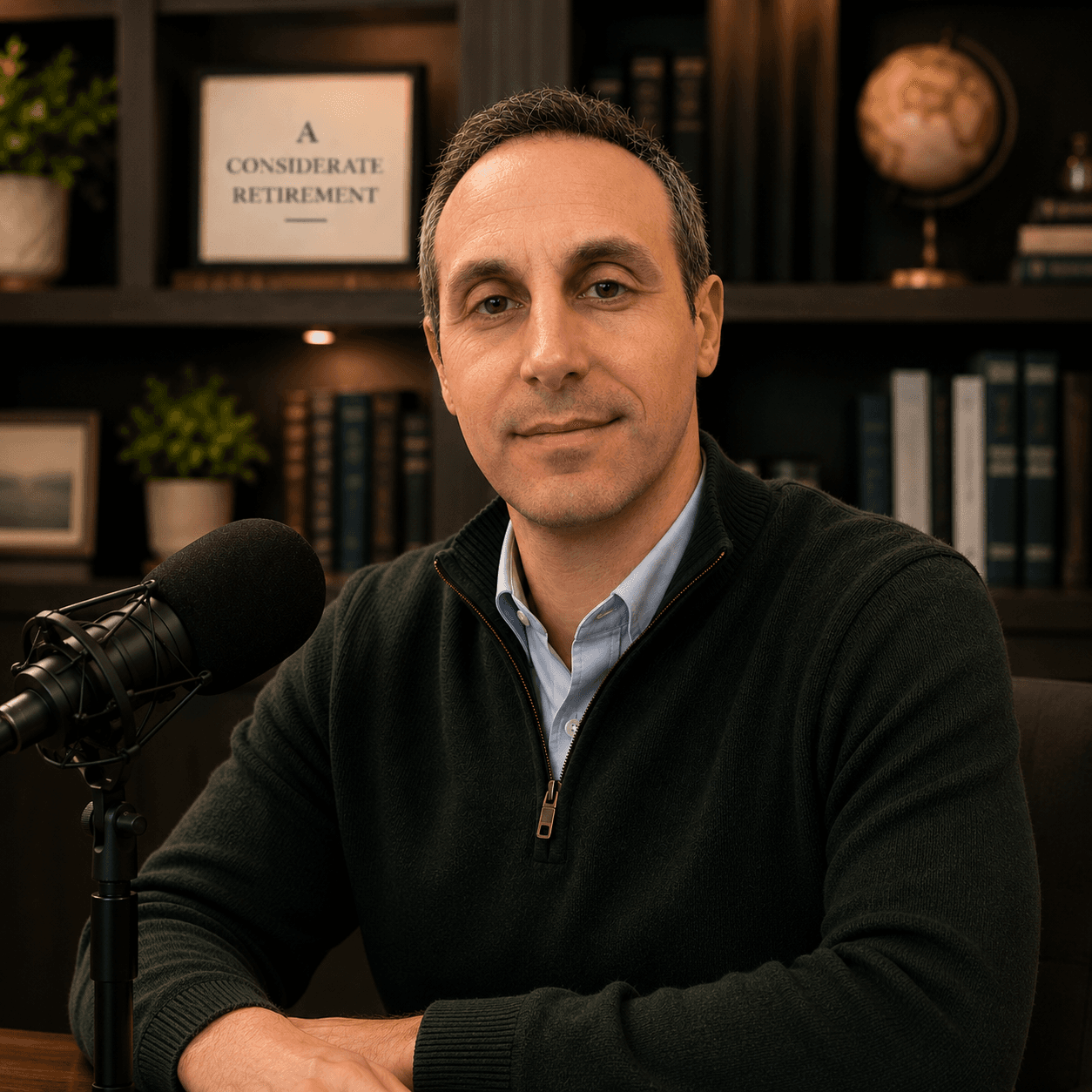
Joshua Mangoubi, CFA
Founder and Chief Investment Officer of Considerate Capital, a fee-only fiduciary. Each episode takes one real retirement question and turns it into a useful, unhurried conversation.
Please read carefully. The full text is also available on the Disclosures page and in our Form ADV Part 2A.
Considerate Capital, LLC ("Considerate Capital") is a Registered Investment Adviser. Registration does not imply any level of skill or training. Advisory services are available only to United States residents. For information pertaining to our registration status, the fees we charge and how we are compensated, additional costs that may be incurred, our conflicts of interest, any disclosed disciplinary events of the Firm or its personnel, and the types of services we offer, please contact us directly or refer to the Investment Adviser Public Disclosure website (www.adviserinfo.sec.gov) to obtain a copy of our disclosure statement, Form ADV Part 2A. In addition, our Privacy Notice outlines how we handle your non-public personal information. Please read these documents carefully before you make a decision to engage Considerate Capital.
This material is limited to the dissemination of general information about Considerate Capital's investment advisory and financial planning services that is not suitable for everyone. Nothing herein should be interpreted or construed as investment advice, nor as legal, tax or accounting advice, nor as personalized financial planning, tax planning, or wealth management advice. For legal, tax and accounting-related matters, we recommend you seek the advice of a qualified attorney or accountant. This material is not a substitute for personalized investment or financial planning from Considerate Capital. There is no guarantee that the views and opinions expressed herein will come to pass, and the information herein should not be considered a solicitation to engage in a particular investment or financial planning strategy. The statements and opinions expressed in this material are relevant as of the date of publication and are subject to change without notice based on changes in the law and other conditions.
Investing in the markets involves gains and losses and may not be suitable for all investors. Past performance is not indicative of future results. Information herein is subject to change without notice and should not be considered a solicitation to buy or sell any security or to engage in a particular investment or financial planning strategy. Individual client asset allocations and investment strategies differ based on varying degrees of diversification and other factors. Diversification does not guarantee a profit or guarantee against a loss.
Some content on this website is produced with the assistance of artificial intelligence tools and is reviewed by a Considerate Capital adviser prior to publication. We make reasonable efforts to ensure accuracy but cannot guarantee that all AI-assisted content is free from error. References to third-party authors, books, tools, custodians, or other external sources are for informational purposes only and do not constitute an endorsement. If you identify an inaccuracy, please contact us so we can review and correct it.
Calculators and reference pages on this website are educational tools for your own use. They apply published rules and official figures to the numbers you enter, produce hypothetical estimates under stated assumptions, and are not personalized advice or a guarantee of any result. Figures change when the law changes. Do not rely on a result without consulting a qualified professional. Their use, and any website's permission to link to or display them, is governed by the Terms for the Tools at consideratecapital.com/tools/terms.
Considerate Capital does not solicit, publish, or use client testimonials or endorsements. Any quotation, story, or reference to an individual on this website is illustrative or educational in nature and is not a testimonial regarding the firm's advisory services. Mention of a third-party author, podcast guest, or public figure is not an endorsement of Considerate Capital by that person, nor an endorsement of that person by Considerate Capital.
Any social media account operated by Considerate Capital is intended for general communication and educational content. Social platforms are not a secure channel and should not be used to share personal financial information or to give instructions about your account. Comments, replies, or messages posted by third parties do not reflect the views of the firm and are not reviewed for accuracy.